Wednesday, September 26, 2012

Back from the Borderlands: Two Tastes, and Two Kegs (always keep one in the fermenter)


Wow, it has been a while. A lot has gone on, and my lack of updates has been due to equal parts of a new xbox game, visiting good friends, as well as my aversion to having to write a really long post. I finally managed to get myself on it tonight, since there is only more beer coming, of which must be written. This isn't the lightest reading, so I should keep it as short as I can...
Enjoying autumn amidst canned farmhouse, friends, and nostalgia. I have only brilliant excuses for not writing

First things first: the Simo. I was pretty damn eager to get a taste of this one for a while, and finally had my wishes fulfilled last week. It conditioned for about 3 ½ days in a keg at 30psi (per recommendation—I’m new to the area of kegging). It worked out damn well, pouring slightly heady-er than I would have liked. The taste however was phenomenal. Heavy coco/hazelnut characteristics from the malt, with a fine accompanying hop bite at the end. It weighed in at about 9.5% and you can sure taste it. There is a bit of a warming feeling after the second sip (or so),that signals a high ABV, but nothing offensive.
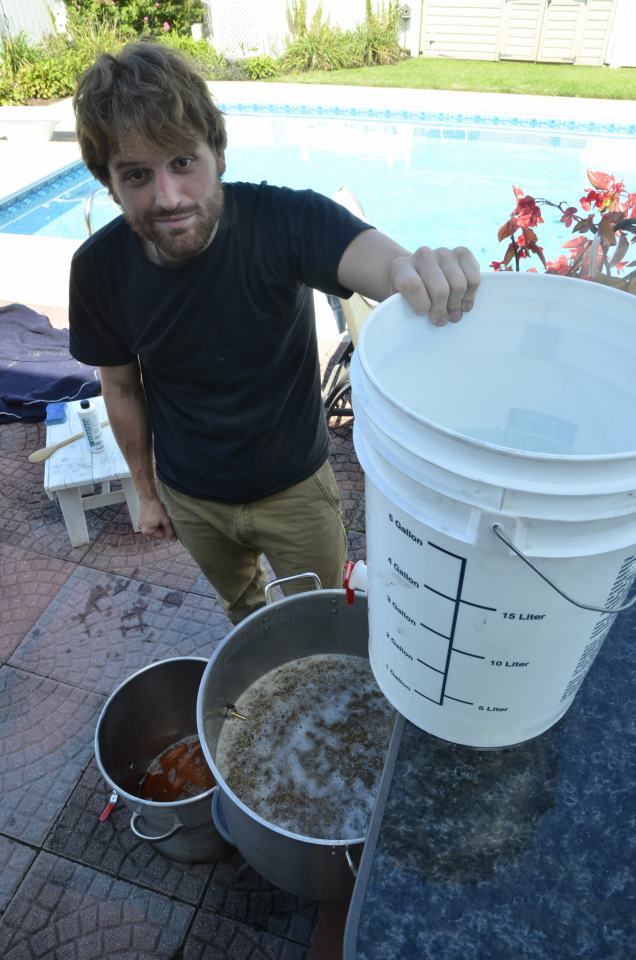
Despite what you may think, this is a shot of me at work. 

 It’s a brilliant beer. I’ve gotten loads of compliments on it from everyone that’s tried it, but it could be heaps better with a bit of aging. So of course, I now have two 500ml, corked bottles sitting in my cellar. They will be opened for New Years. As is tradition.

Second up is the Tarakena. This was my first personally-kegged beer, and I’m decently content with the results. An odd descriptive, I know, but it really is the only way. This beer is good. The malt profile (to remind, is a Saison build) is spot on, and the hop additions are perfect. The issue is that upon first taste, the beer screams BELGIUM. The golden ale yeast was a hell of a lot more potent than I thought it would be (in retrospect, it’s a Belgian yeast. That’s like a French recipe in cooking—if it doesn’t floor you it’s not worth trying). The yeast character completely stole the show from the chamomile, ginger, and mint. There is a decent orange character in it, however, which really compliments the NZ hops. The ginger also makes a brief appearance, but otherwise, one would never know I used chamomile or mint.
Achievement Unlocked: Color perfection

I’m really tied, because I like the golden ale yeast flavor, but need it to be subtler. The ABV is moderate (about 6.4%), so I don’t want to short the amount of yeast pitched, and so I believe the solution is to change the yeast (which I’d be somewhat alright with) or to increase the mint and chamomile. Its really looking like I’ll have to do an experiment with this one, and do a split batch with both options to see what works best. It has a hell of a lot of potential, and so I would love to get this one down to near-perfection.

Now that the tastings have been covered, it’s time to move onto what’s still fermenting. I’m going to cheat a bit, however, since the first beer I’m covering is now in a keg. The Smoked Weizenbock(WB) is a troubling beast. I’m concerned because I had high hopes for this one and it has been—nearly—my Titanic. While the fermentation seemed fairly vigorous, it only dropped the gravity by a miniscule amount. Going into secondary it was only 1.042…


To make matters worse, I completely overlooked my fermentation set up. When I racked the WB into the secondary, I realized that I didn’t have a stopper for the damn thing. Amidst my panic I used some plastic wrap and a rubber band to ‘seal’ the opening—a strategy I picked up from some book I read somewhere along the line for making yeast starters. I kicked myself all day and made sure to get a proper seal as soon as I finished work the following day.
Low gravity, but promising taste. Why you gotta play me, Weizenbock?

I’m remaining optimistic however. It was only a jerry-rigged airlock for less than 24 hours, and upon tasting the into-keg-product today I didn’t get any signs of an infection. I am wary, however, about what I put into that keg. The gravity didn’t change from 1.042, so the ABV is roughly 5.4%—much lower than I wanted. I’m not entirely sure as to why it crapped out on me, but after reading Dave’s contribution, the issue may have been my general ignorance to the particular yeast. Perhaps I should have added more to the fermenter—the yeast presence is very subtle-to-nonexistent.

On the positive side, though, the malt profile is a thing of beauty. It has a dark fruit/date/sweetness to it, and a nice bitter bite that’s about half malt-based, half hop-based.
If you look closely, you can see bits of my perfectionism floating to the bottom...with my dreams

In addition, the level of smoke in the beer is spot on. I’m glad I showed some restraint in that area, because it is quite literally on the line of being too much for liberal WB interpretation. Overall, I think that as long as the lower ABV gets forgiven (and there is still no infection: fingers crossed), it could be an appreciated take on an already enjoyable style.

The other fermenter, of course, contains the pumpkin ale. I’m fairly certain that this recipe is flawless, because goddamn, I think Shiggy and I are going 3 for 3 on medals for this sonofabitch. Transferring into a secondary, the gravity was perfection: 1.012. At 5.5%, it’s a pumpkin ale that won’t put you on your ass, yet is still enjoyable. And tasty it is! My nip from the transfer was heaven. I would drink this beer uncarbonated. The dropping of the clove and cutting back on some of the spices helped immensely, especially with increasing the amount of pumpkin. Uncarbonated, the beer tastes thick, rich, subtly spiced, and frankly, bitchin. It will be going into the keg tomorrow (after bottling the remaining Tarakena).

Phew, what a lot to catch up on. Now onto the new things, as well as planned ventures! I weighed out the remaining Serebrianka hops the other week, and realized I had roughly 350g left….single hop IPA? Yes. I thought I could also sneak in some research for a future recipe and used a theoretical malt profile I had been planning. It consists of Maris Otter, Victory, and Crystal 60 (in decreasing % order). I did the same hopping technique used for the Cascadian Ancestral, but kept it around a total of 60ish IBU’s (following my only reference of 8Wired’s Tall Poppy…) I used the American ale yeast blend, and HO-LY-SHIT does that yeast work! 22L is currently still fermenting heavily—after a week and a half—with an OG of 1.066. I plan on transferring it to a secondary when it calms down a bit more, which it does seem to be slowing. I’m taking my time with this one, though, because I may have found the yeast/malt build for my Fenrir…

The only other thought that I had in regards to a Fenrir build occurred during my visit to CafĂ© Bruges today. They stock a new beer called the Svea IPA, which was damn good. What interested me most about it was the malt profile. They used everything. Barley, oats, wheat, and rye…it made me think. My idea of Fenrir is—obviously—something delicious, with some very specific flavors. But if I could get the same backing that this beer had along with the creativity of using every brewing grain possible…well that only feeds the beast more (appropriately so!).

Food for thought.

If you’re still with me, I may as well discuss the next two recipes in brief. Wheat wine. Round two. This time it will be what I want. I’d love to get this baby straight into bottles, and age it until new years. Only issue is—of course—not diluting the fucker again, as well as having it taste like a wheat wine rather than a hard, hoppy, wheat ale (I like the idea of the Hard (hugh)Heff, but I want to make reality what I imagine, not settle for calling screw ups my ‘works of art’).

The other was a recipe that slapped me across the face, and begged me to make it. Bored at work, I tossed through an ancient beers book and found a rudimentary recipe for a ‘beer’ called a Gotlandsdricka. With a name like that, it has to be made. Not to give too much away now, but it’s going to be smoky, sweet, and use juniper in some pretty awesome ways. It’s recipes like this that make brewing so much damn fun.

No real meaningful lessons learned for this entry (the WB will probably have a few once it is in a drinking state…), except for one. Refrigerators with a two-corni keg-capacity are hard to find, and even harder to transport in a small car…

Serebrianka Single Hop
Maris Otter, Victory, Crystal 60L
Serebrianka
American Ale Blend (WLP 060)

Tuesday, September 11, 2012

Two Beers in Two Days: Brewing up a Competition!


This will be a big one. Along with the usual updates, on beers in progress, the story of the weekend must be told as well. Two beers in Two days is a tall order, but I had help, thankfully. This week produced a Smoked Weizenbock and a classic Pumpkin ale specifically for entry into the Maryland Oktoberfest. Overall, it was a great weekend to brew, and having good, talented company made it all the better.

I may as well keep this in chrono-beer-o-logical order, and start with the beer on deck. The Simo Imperial Brown ale was transferred to a secondary fermenter last week, and is looking pretty as all hell. I got a nice cylinder full for a gravity reading and It’s going to end up being around ~9ish%. Not brilliant for an imperial, but acceptable for sure. After I tasted the sample, I will most definitely accept it. Even without carbonation it tastes beautiful. We’ll be putting it on tap at the shop this week, and goddamn, am I drooling to get a proper taste of it.

Though not quite in order of the events as they happened, I transferred the Tarakena to the secondary. It was doing the classic slow, annoying Belgian fermentation, but was still going steadily (but slowly) when I transferred it. The reason I did it ‘early’ was to make room for the other two beers, and yet still get some clarification from the re-racking. I may have performed a pointless act, though, since the fermentation wasn’t over. We’ll see. I’ll probably cheat a bit and buy some clarifier tomorrow. Hopefully that will give me a better result. I guess I’ll just need more carboys…

I'm a busy brewer. I gotta feed the addiction
I’ll definitely need to sit down and figure out a strategy for carboy rotation now that I have all three fermenters occupied. Two beers in two days…some might think its overkill, but I like to think I’m only imitating those I admire (cheers, Garage Project). My friend Grant came up to help me this weekend as well. He was a heavy influence on Sunday’s beer, believing that we should enter something German for an Oktoberfest competition. And it should be smoked (of course). I tossed around for a while and wrote up a recipe for a smoked weizenbock. When prompted to give a name to such a design, the Dane always provides: “Two Smokin’ Barrels” is fermenting vigorously, and will be entered first in the Maryland Oktoberfest.  


::obligatory grain-in-hands-shot::
Having someone help was fantastic. I may have to incorporate friends more often…. It also helps for other projects—such as this blog—if the friend is a brilliant photographer. In between lift-work steps, Grant took some fantastic brew-porn shots. Photos aside, he helped make the entire brewing process heaps easier.

We were given a pretty fantastic weekend to brew as well. Two days of gorgeous sunny skies, and a cool autumn breeze. Clearly, we had to brew it all outside. And brew outside we did. I used my normal mash technique for the weizenbock(WB), but added a decent rest on the end for the fair amount of wheat malt that was used in the recipe. I sparged out, keeping a close eye on gravity and getting about 20 litres of wort to boil at 1.064. And the color of the beer was….pure…Sex.

Seriously. All it needs is booze and carbonation and its fucking perfect
The boil was nothing out of the ordinary either. It consisted of just two additions of Tettnang over the course of a 90-minute boil. After the cooldown we transferred into the carboy, and measured in at about 3.5 gallons (14ish litres?) at 1.082 OG. The gravity is going to make it an intense brew, and most of that is due to the volume boiled off. I’m definitely marking this as an issue, since this now makes three beers in a row that were under 20 litres going into the fermenter. I am most certainly not a fan of this trend.

Though it is not the worst problem in the world, it is a consistent problem that needs to be solved. I partially attribute it to my paranoia from the wheat wine incident (where I diluted the wort too much). I’m too concerned about getting a decent gravity rather than get the volume for a decent mash efficiency. Although I was a bit wary to go with my first instinct to solve this issue, I ended up following my hunch. Thankfully, it turned out to do a pretty good job of fixing the issue.

OPERATION PUMPKIN RESCUE
I decided that for the pumpkin ale we did on Monday, I would get the volume I wanted rather than embark on the usual quest for the perfect gravity. I was a bit nervous to do so, since the pumpkin ale will also be an entry in the competition, but I believed that learning is learning, and that I wont win anything until the beer is 100% through the process.

I used my normal mash (again), but this time sparged until I reached a pre-boil volume of about 23 liters. I was a bit concerned at first test of the pre-boil gravity, since it was only at 1.042. I kept repeating my mantra for the day, however (me—‘it will boil off, the gravity will be fine’), and went about as usual. It was just a 60 minute boil, adding US Saaz (in place of the original Motueka), as well as dropping the cloves from the original recipe altogether.

The rest of the ingredients consisted of about 2.3kilos of pumpkin with some allspice, nutmeg, cinnamon, and brown sugar. By the end of the boil, the beer smelled brilliant, and even the taste was great (albeit sweet—duh). Best of all, the beer’s original gravity finished up around 1.054, and measured up to 18 liters. While the gravity isn’t exactly what I hoped for, it will give me a good level of alcohol appropriate for the style.
Not pictured: the baked pumpkin seeds we lustfully devoured 

So clearly, the lesson for the day (or weekend, rather) was that I need to remind myself that fucking up is totally fine. Though the turn around process of brewing takes a lot longer than most hobbies, a complete failure won’t leave a hole in my pocket. And it certainly will not leave me with wasted time. With the records that I keep, I’ll be able to detect exactly what went wrong, what to fix, and will—overall—be better off from the experience. I took a leap from my comfort zone in guessing the boil-off amount, but it worked out well. I might have to use the finer calculators in Beersmith now…

brewing barefoot, however, is totally within my comfort zone.
To close it all off for this entry, the fermentations are going great. The Tarakena is up to speed again after the secondary transfer, and the pumpkin is going along nicely. Best of all, Two Smokin’ Barrels is fermenting like a rage-fueled monster. While I’m excited for all of them, I’m definitely most eager to see the results of the WB. I’ve never made anything like it before, and so far, everything is going along brilliantly.

Raise a glass for good luck to the WB and Pumpkin ale competition entries. Let’s hope a nuveau-fusion interpretation of a German classic will be accepted among the judges! And more so, lets see if this pumpkin ale recipe can go 3 for 3 in terms of winning medals!

(All photos are credited to the His Most Honorable Vikingness, Herr. J. Grant Knud-Hansen, TGT)

Two Smokin’ Barrels Weizenbock
Torrified wheat, Belgian Pilsner, Melanoiden, Caramunich, Special B, German Rauchmalt
Tettnang (4.5%)
Dusseldorf Alt (WLP036)

‘Ajack’ Pumpkin Ale
Maris Otter, Munich, Crystal 120L
US Saaz
California ale (WLP 001)
Pumpkin, cinnamon, nutmeg, brown sugar, allspice

Tuesday, September 4, 2012

Tarakena Summer Ale, and Cascadian #1 results


Lots of things happening since the last post. I have a feeling these pieces are going to get much more involved in the near future. Next week, is looking like two beers in two days, both of which are to be entered in the Maryland Oktoberfest homebrew competition: A smoked weizenbock (affectionately called ‘Two Smokin Barrels), and a remake of the gold medal pumpkin ale. Beer crazy? Maybe. I just like learning and beer. Thankfully, brewing provides plenty of both.

So first off, I should address the result of the Cascasdian Ancestral (#1).  Though the number should be enough to signal my intentions, It bears stating that I plan on making another batch. It has perfect color, could use some clarity, but definitely needs progress on taste. As of now, it’s a toss up on what I’m thinking needs improvement, but one fault I’ve nailed down. Thanks to my excruciatingly detailed brewing notes, I know exactly where the off flavor came from.
Looks how I wanted, but full of things I didn't anticipate. A cruel mistress....

When I first tasted it, I thought I had some overly-fruity notes, as well as some diacytal. When I brought a six-er with me to a Maryland getaway with friends, I noticed that the fruity notes had disappeared. Probably just premature opening/not enough conditioning. The diacytal remained, however, which really surprised me considering the fact that I left the fermentation to go a bit longer than I thought was necessary. It’s nothing offensive, but not David Wood-worthy.

A hint of oxidation is present from my lack of bottling nozzle. I had to use nothing but the faucet on the bottling bucket to fill the bottles up. The lesson from that experience may be overkill to some, but for me, it’s nothing short of necessary. I’m getting a keg setup for the next brew. No questions asked.

Regarding the next brew, I’m quite excited about this one. As I mentioned before, I’ve been eager to recreate Coronado’s Saison by the Sea. While not really a saison, it was a super drinkable beer that had all sorts of delicious summer-appropriate flavors in it. The only ‘recipe’ I had to go on was what I recalled from the ingredient listing on the bottle I had a year ago. Reliable? Not really. Potential for individuality? Extreme.

I figured my summer beer of choice is in fact the Saison, so I chose the malt profile I used for the one I made in New Zealand. It is very simple, but gives a good body for a summer beer. The other ingredients I knew I wanted (/somewhat recalled) were chamomile, spearmint, ginger, and orange. The way to figure out how much of each to use was a bit of a task. It eventually finished with a taste test of the most unfamiliar ingredients soaked in hot and warm water for an hour and a half.
The luke-warm samples. And 8 disassembled tea bags.

The results were actually quite informative. The chamomile in hot and warm water worked well, but delivered brilliant aroma and taste in the hot water in small quantities. I figured from that I’d use it in the boil, around 15 minutes. Through another method I figured a ½ tsp per gallon was a good amount (based on the teabag size/cup). As for the spearmint, the hot water was out of the question. It produced a brutally offensive flavor that would be unbearable (or at the very least not even a remotely close) flavor for the beer. In the luke-warm water however, it gave off a hint of a mint taste, as well as a tinge of aroma. Dry-hopping was definitely the answer for the spearmint.
All of the boil additions. Minus the ginger....

As for the ginger, I completely forgot to add it in the boil. My solution is to dry hop it (shave the root then dry it, so that the beer rehydrates it), with the spearmint. Hopefully that will give it a mild ginger tinge, but nothing offensive or too powerful.

While the other ingredients were an easy choice (thanks to my memory of the Coronado label) the hops took a bit of thinking. I had a few things in mind, but it really all came together when I noticed that there was a perfectly appropriate amount of hops from New Zealand left in stock at the store to produce a nice Summer ale. Pacific Jade was my bittering, and NZ Hallertau brought up the aroma and flavor. I also tossed in a few extra PJ in the flameout for a (hopeful) extra citrus.

As for the yeast, I wanted to try something different, yet complimentary to what I was looking for in taste. I chose a Belgian Golden ale strain to accent some of the fruitier characteristics. Hopefully that’s what it will do. This is a new yeast for me, and using unknown yeasts is always an adventure…
A little sparge-porn for you hedonists.

I had also tossed around names for this brew for a while, but it really came to me after I made up my mind on the hops. The beer is something I want to have fruity, juicy, citrusy characters, as well as a hint of flowers, and a touch of earthy (balancing) bitterness. The best way I can sum it up is to say that it should taste Teal. Like the color. Seriously. Think about the color teal. If it helps, think about it in context to a tropical ocean—not in a HOT location, but one like New Zealand, where it is cool—thanks to the wind. The ocean breeze and the blue waves come up and crash against the rocks on a partly cloudy day, and its just paradise. THAT kind of teal. Cool, refreshing, quenching.

While thinking all of these things, a single spot came to mind. I made a point to take a break there every time I did my 30 mile bike circuit around Wellington city. When you ride uphill for a good while in Seatoun, you’re suddenly greeted by a narrow pass cut through a hillside. Following the road, you’re assaulted by the view of the south sea (next stop, Antarctica), and a blast of fresh sea air. Open ocean spreads out before you, and it is nothing short of perfection.

Tarakena Bay. If I can make a beer anywhere near as fulfilling as that spot, I’ll consider myself well on my way to being a reputable brewer.


End note: I felt like experimenting with the copious amounts of grains I was using. So I made a  couple of loaves of beer-grain barley bread. It. Tastes. Brilliant.
I really do not understand why more people don't get into this hobby

Tarakena Summer Ale
Beglian Two-row Pilsner, Vienna, Torrified wheat
Pacific Jade, New Zealand Hallertau
Belgian Golden Ale (WLP570)
(Chamomile, Spearmint, Ginger root, Orange peel/zest)

Friday, August 24, 2012

Never Saw it Coming: the Simo Hayha Brown Ale


So, it has been an extremely eventful few weeks. I left one job, and got another at a homebrew store. So far its going great, and its always a pleasure going to work. When things get boring I just plan what to brew next. Life is clearly not sucking. To top things off, I checked the gravity on the Cascadian Ancestral after my week in Seattle to discover the yeast had an intergalactic kegger while I was away (or perhaps a reverse kegger?). I didn’t believe the reading so I tasted the sample I took. Turns out, 8.7% is the legit abv. MUCH higher than I intended, but this now confirms that my FG readings were not ‘hogwash’. It’s a bit bitter, so it seems Beersmith was telling the truth about the IBU’s. I’m pretty sure the carbonation will balance things out though, because otherwise its tasting fiiiine.

The beer this week was entirely unintended until yesterday. Working at a homebrew supplier has its perks. While the endless grain, hop, and yeast supply is good enough for anyone, the place I work also teaches classes. This means that they have brewing equipment on hand that can be used. This also means that, on really boring days, when all the work is done, the employees need something to do…
Que Mad-Scientist-Maniacal- Laughter 
Well, it was a really slow Thursday at the store, and the one manager’s bitching reached its peak with him addressing the empty room with a loud, ‘FUCKING HELL THIS SUCKS’. I thought I should calm him down with some light humor, so I suggested we should brew since we’ve got all the equipment to do it. He looked me in the eye for a moment then said,
            ‘Ok, bring in a recipe tomorrow, and we’ll do it.’

After a few moments of trying to gauge the level of sarcasm and finding none, I spent most of my energy trying to act nonchalant rather than a giddy 10 year old on Christmas morning. So that is how I got access to a brilliant range of devices and utilities to brew. And since I could now do and use essentially whatever I wanted for ‘work-related purposes’, my mind went straight to the most complicated recipe I hadn’t yet brewed. Imperial Brown Ale it was.

For those that have not experienced god’s love, Nogne O Imperial Brown Ale is perhaps the epitome of brown ales. In its prime it is flawless (in my opinion as well as many many others).  The recipe I used is one that is supposedly a clone of the Norwegian beer. I actually cannot remember where I found the recipe, but since the Nogne O brewer himself seemed to think the yeast and hop additions were good I’ll assume it is to be at least an honorable tribute to his glorious creation.

In the process of the day, I finally got to take advantage of the grain wall. The amount of imagination that poured out of my skull when I first saw that beautiful structure was nauseating. Most homebrewers would need a change of pants after seeing it, and I was told to choose what I needed, and have at it. Pay? Nope. It was time to get eight kilos of grain on the house. Fuck. Yes.
Thats not the wind. Just the sound of a thousand glorious beergasms

On top of the wall-o-grains, I was introduced to my new lover. Her name is the Blichmann boilermaker and burner. 20L of COLD water brought to a boil in 10 minutes (roughly enough time to help two customers). So much brewing porn; too good to be true.

After today I’ve also decided that I’m going to brew with more people more often. Everyone has their pet-peeves and their habits, and what they think works best. For me, I get my jollies off of learning mashing techniques. Today’s was one I never heard of before; a sort of tweaked decoction. My coworker began describing it to me and I just went along with it, bowing to his experience, as well as succumbing to my urges for unorthodox mash-study.

Added the hot water to the Gatorade-cooler mash-tun first, and then stirred in the grain in small amounts. Instead of letting it sit for an hour, we left it for a mere 30 minutes. In the meantime, we boiled about a half gallon (nearly 2 liters) of water, and then scooped out 8liters of the mash mixture into the boiling water—grain and all. That concoction was then brought to a boil, and then transferred back into the mash tun, where it was mixed in once more. This then rested for another 15 minutes. The time complete, we opened the valve and drained the entire liquid contents of the tun into the kettle.

As for sparging, we had another cooler filled with another 5 gallons of hot water, which we added to the ‘dry’ mash tun. This rested for 15 minutes, and then was drained/added to the kettle up to the desired boiling volume.
The first 'sparge' into my new lover. You know you like it

Though my coworker advocated using seven gallons, I followed my own judgment and went for six gallons instead. The guys at the shop are not incredibly wild about the gravity recording idea, which I find insane. Maybe its my kiwi (brewing) upbringing, or that I’m just all about being able to repeat things I do (or possibly the fact that making this hobby a profession isn’t completely out of the question), but recordkeeping is something I’m anal about. Regardless, the gravity was testing lower than desired at six gallons, so I called it quits there.

The boil, again, was easy enough. Chinook at the start of the 90 minutes, heaps of US Golding at 10, and some Columbus at 5. Used a gorgeous wort chiller AND an ice bath to cool the beast down, and then tucked it in with some Dry English Ale yeast in a 30L glass carboy.
Just a taste of the mind-blowing selection i had to choose from 
Overall, it was a super easy brew day. The thanks must definitely be extended to the fact that I didn’t have to drop a penny for anything, and had access to near-professional equipment. As for the new mash technique, it worked well, but I’m not fully convinced. The hands-down, best mashing process I’ve used so far still has to go to the wheat wine-mash. Though it was a nearly two-hour process, it prevented a 100% wheat mash from getting stuck, and—had I not diluted the bastard—would have produced a perfect gravity.

I plan on using this mash technique again with my next beer. I’ll be doing one more before my second attempt at a pumpkin ale, which will be a Summer ale. It will be attempting to reproduce something along the lines of Coronado’s Saison By the Sea. After that, however, there are two competitions coming up that I will be entering. The first is the Maryland Oktoberfest homebrew competition, which I will be working with my good friend to produce three entries. It will be a 50L mash, split into three 15ish liter batches. The plans are up in the air, but one will likely be the pumpkin ale. As for the other competition, that is a PA-based venue, and I may have to conceive my long-contemplated Fenrir for that one.

Lesson of the day: 30L of beer should not be moved alone. My right bicep is seared medium-rare.

Simo Hayha Brown Ale (Nogne O Imperial Brown Ale clone)
Maris Otter, Belgian Wheat, Munich, Crystal (20L), Amber, Brown, Chocolate
Chinook, US Golding, Columbus
Dry English Ale (WLP007)

Friday, August 10, 2012

Cascadian Ancestral


First Stateside beer! It turned out to be quite the adventure today. Though I began the process around 10am, I didn’t get any fire lit until about 2pm. A lot of unexpected things happened, and a lot of improvisation occurred. Thankfully, the next beer will be much easier thanks to the pioneering that was performed today.
The ingredients  
The day started off with coffee and cleaning. The first thing on my list was to clean the brew equipment I got while I was home visiting over the holidays. It seemed that during the move to the new home, some of the yard maintenance guys decided my brewing buckets would work really well for transporting excess weeds and dirt. Put simply, I spent a lot more time getting things prepped for brewing than I originally anticipated.
British and Russian hops, with American soil. Tastes like Liberty 
The cleaning done, it was onto heating up some mash water. I had a bit of trouble lighting the burner, and quickly realized that the valve on the extension hose wasn’t open. The burner has a piping input, not a propane input. After some panic I hopped in the car and drove to find something to open the valve, and free the gas for the burner. Success? No such luck. I got nothing but strange looks when I presented the dilemma, so I thought I’d run to the local brew shop.

Turns out, I ended up buying a backyard turkey fryer. I used the pot that was included to heat up sparge water later on in the day, but the point of the purchase was a good burner. It ended up working really well, came with a solid stand that provided good flame ventilation. It gives off great heat, but it chars the bottom of the pot. I spent a good portion of time wiping black soot off of damn near every surface of the back porch later in the day.
Not bad for a Wal-Mart $30 
The beer was a mash of about 6 kilo of grain in 20litres of water. I held it at a (at least) solid 58C. The thermometers I had were pretty old fashioned, and not the most accurate of instruments. I could have mashed a bit hotter, and next batch I definitely will be doing so. The beer was mashed for an hour holding that temperature, and then I moved the equipment outside where the weather was gorgeous.

Since I was using the 37L pot as both a mash tun AND kettle, I had to sparge into a cooler, rinse the kettle, remove the stainless threaded filter, then transfer the wort back into the kettle. It was a bit easier than I thought it would be, and was much more surprised to find that my mash almost stuck. I did a beer with 100% wheat malt and it went flawlessly, yet a pilsner/caramalt mash nearly sticks. The grain may have been a bit too finely crushed, and I do remember seeing some of it be nearly powder-like. I’m thinking a grain mill might not be too bad of an investment soon.

Speaking of that 100% wheat malt beer, it’s worth noting that accidently diluted that beer during the sparge. I sparged too fast, and the gravity was pitiful. Since then I’ve been incredibly paranoid about my sparging, and today, I believe I tested the gravity every few minutes. The pre-boil gravity was decent, 16L at 1.056. I didn’t get 18/20 L because of the last gravity test from the mash tun dropping down to 1.052. In retrospect, I probably could have gotten another 2 litres without much effect on the overall product, but again, I was paranoid after the last experience.

The boil is what I know. It’s pretty hard to mess up as long as you keep an eye on the clock. The Fuggles was my bittering, and starting at 40 minutes I did a Dogfish-esque continual hopping of Serebrianka. Adding a bit at a time of the leaf hops gave it a gorgeous smell, and I’m pretty excited to find out how this hop works within the beer. In total, the hop count came to 350g. They’re both pretty low alpha hops, so I plan on dropping a few more Serebrianka for dry hopping. Beersmith is claiming the IBU’s are going to be a bit high, but I’m mildly skeptical since it also claimed the same of the beer I did with Greg, and that wasn’t hoppy enough.
Around the final addition of Serebrianka 
And if the final gravity is correctly measured, it should be fine. I measured it at 1.076. I did a second measurement because that was just too good for me. After getting the same result, I began checking other things, and soon came across the realization that I was at a volume of 10 liters. I boiled off nearly 6 liters, which made things a lot more believable. Since I was using leaf hops, they may have absorbed some of the liquid as well. Either way, I’m currently sitting 10ish liters of beer in a fermenter. I even got some bubbling starting already.

As for potential issues that may arise, the airlock on the fermenter keeps dropping in liquid level. It plateaus eventually, but it’s below the ‘fill line.’ It may be cracked but there should be enough water to do the job right. I also dropped the thermometer in the kettle after the boil. Most of it was sanitized, but not the top, so there is potential for contamination there. The pre-boil gravity was below the Beersmith prediction, but the OG was slightly over the prediction. I’m still a bit wary of the OG, though. I feel it may be too good to be true, but we’ll see.

Overall, while it’s a bit less in volume than I usually like, I’m pretty satisfied so far with this as a first beer. Considering all the damn trouble I had to go through, it definitely worked out well. Lesson learned from today: Test the shit BEFORE brew day. 
Improvising with anti-buoyancy, and rain to cool down the beer

'Cascadian Ancestral' (Parent Hops to US Cascade)
Pilsner, 20L Caramel
UK Fuggles, RU Serebrianka
US-05

Friday, August 3, 2012

An Introduction to the Beginning

When one takes part in a practice requiring fine attention to detail, it is crucial to keep equally fine records.

I normally do not consider myself a perfectionist.  However, when it comes to brewing, I've found I am at my most meticulous. This isn't to claim I'm a flawless craftsman, but that if what I create is not what I imagined, I will search relentlessly for the answers as to why it fell short.  I develop a concept in my head, and that is what I seek to create. It is about bringing an idea into reality. It is creation, and nothing pleases me more than to witness the existence of something that was once nothing more than a simple thought.

The purpose of this blog is simply a public notation on my records, and projects. I prefer to type rather than write when it comes to 'thinking on paper', and so I decided to use this medium among other options.

To lead into things, I have been slowly gathering equipment for what I need. I can't resist following Shiggy's (the one who taught me to brew) influence in terms of hardware, and will eventually be upgrading the mash tun to a stainless steel model. For now, i've just converted an old Igloo cooler to meet the needs for all-grain mashing. The kettle came in today as well, an approx. 40L stainless with a ball-valve. Dont think I'll be using the ball valve much unless i can find some plastic tubing to fit snugly over it for clean transfers.

Also invested in a 23-head burner that should move things along nicely. Other than that, I'll be making use of the basic homebrew kit items. Next on the buy list is a quality carboy. This first beer will be the last one in a bucker fermenter. I haven't had any problems with bucket fermenting, I'm just not fond of them. It doesn't feel secure enough for me.

The first beer is going to be a fusion of research and gimmick. Ever since I read an article in a Beer Advocate, I've been obsessed with trying to find and use Serebrianka hops. It's the only "Russian" hop variety that is now US grown. It is hard to find, low alpha acid, and doesn't store well--Its a very un-American hop. The story behind it, is that it was a parent hop to US Cascade (along with UK Fuggles). I always thought it would be fun to make a beer that had Cascade's parents together, and luckily, I managed to find a grower that sells the elusive Serebrianka.

As for the malt profile, I'm choosing to embrace simplicity. Most of the process will be hands-off since I'll be in Seattle for most of the fermentation period. This beer is going to be all about the hops. Not a hop-head beer, however, but more a middle-road pale ale that showcases hop characteristics. To do this, I'll be using a combination I learned from a Kiwi at a homebrew tasting, essentially going heavy on the Pilsner malt, while keeping a 20L Crystal below 20% of the profile. And thats all there is to it.

Continuing with the simplicity, I'm just going with US-05. It's cheap, reliable, but I'm sure I'll change the yeast if the recipe goes well.

It'll be bottle conditioned, but I plan on kegging soon (hopefully before I hit beer number three).

Ingredients are on the way, and the brewing will probably be Wednesday or Friday this week.

-L